Choose the structure before you write a single question. A structured questionnaire fixes every answer in advance, so the results compare across respondents.
A semi-structured one fixes the questions but leaves the answers open. The types and examples below cover both, the mistakes that quietly break the comparison, and how to build the whole thing in a free Google Forms alternative.
Structured survey questions to copy
How often do you use the product?
- Daily
- Weekly
- Monthly
- Less often

Which of these do you use? Tick all that apply.
- Product A
- Product B
- Product C

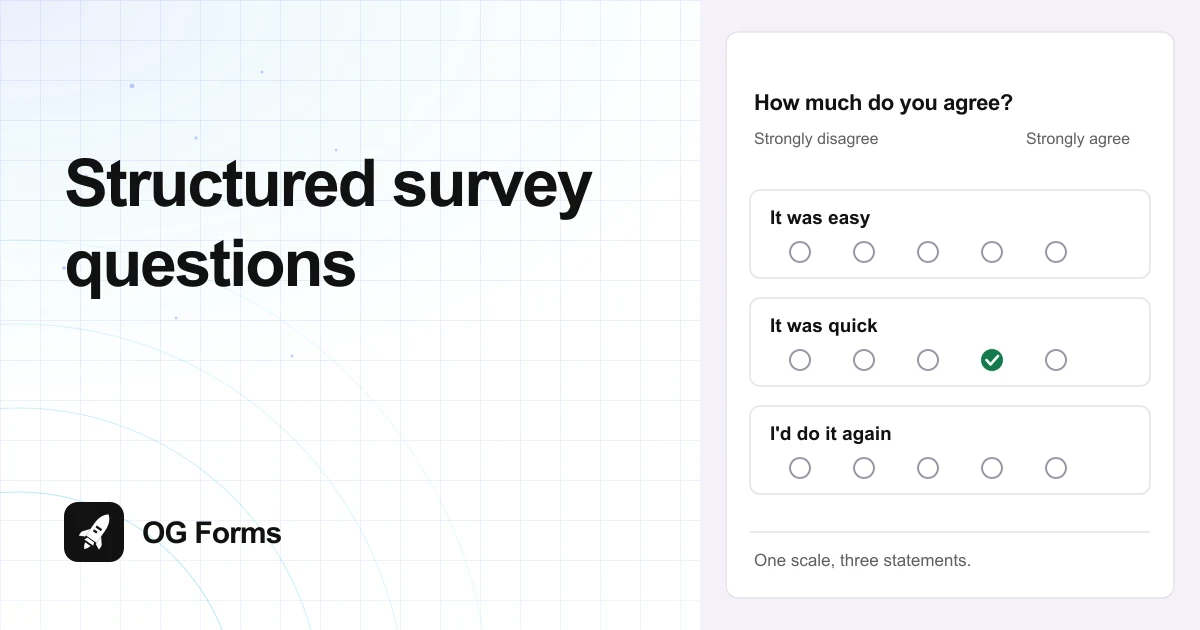
How much do you agree: the setup was quick?
- Strongly agree
- Agree
- Neither agree nor disagree
- Disagree
- Strongly disagree

Rate the checkout from 1 to 5.
- 1 = poor
- 2
- 3
- 4
- 5 = great

Put these four reasons in order.
- Price
- Speed
- Support
- Features

How many people work at your site?
- (number)

What was the hardest part of setting this up?
- (open answer)

Did the import work?
- Yes
- No
What happened?
- (open answer)
Know what makes a question structured
A structured question is closed: it offers a fixed set of answers and the respondent picks one, so every reply is already in a form you can count. The answer set is the same for everyone, and the comparison between two respondents is direct.
A questionnaire is structured when every question is closed and follows the same order for every respondent. One open question in an otherwise closed questionnaire makes the whole thing semi-structured.
Pick between structured, semi-structured and unstructured
Choose the form of the questionnaire first, because it decides what you can do with the answers.
| Structured | Semi-structured | Unstructured | |
|---|---|---|---|
| Questions | all closed, fixed order | closed, plus open questions or probes | open, often shaped by the conversation |
| Answers | options you chose in advance | options, plus free text | free text |
| What you can count | a proportion or an average per question | counts for the closed part, themes for the open part | themes only |
| Sample size it needs | large, because you compare groups | medium | small, depth matters more than count |
| Typical use | customer satisfaction, screening, a census | interviews with a fixed question set, staff research | first conversations with users, discovery |
| Effort after collection | low | medium, the text needs coding | high |
Pick structured when you need a number you can defend. Pick semi-structured when you need the number and the reason behind it. Pick unstructured when you do not yet know what the questions are.
Ask closed questions that produce comparable data
Six structured question types cover most surveys. Each one measures something different.
- Single select. “How often do you use the product? Daily, weekly, monthly, less often.” Measures frequency band. The bands must not overlap and must not leave a gap.
- Multiple select. “Which of these do you use? Tick all that apply.” Measures the set of features in use. Do not use it when you need one answer, because the totals will exceed the number of respondents.
- Likert scale. “How much do you agree: the setup was quick. Strongly agree to strongly disagree.” Measures agreement strength on one statement. One statement per question, never two.
- Rating scale. “Rate the checkout from 1 to 5.” Measures a score you can average. Say what the ends of the scale mean, or the average is unreadable.
- Ranking. “Put these four reasons in order.” Measures priority when everything is wanted and only the order matters. Cap the list at about six items, because ranking twelve is work.
- Numeric entry. “How many people work at your site?” Measures a quantity. Keep it numeric, so the answer is comparable, rather than offering bands you then cannot average.
Two rules make the difference between structured data and structured-looking data. Every scale needs a fixed number of points for every respondent, and the midpoint decision must be deliberate: a scale with a midpoint invites a neutral answer, a scale without one forces a side.
Write the six closed types into a free multiple choice survey template, and the question order stays fixed for every respondent.
Write the semi-structured questions
A semi-structured question fixes the prompt and leaves the answer open. The prompt is identical for every respondent, which is what makes the replies comparable enough to code.
- Fixed open question. “What was the hardest part of setting this up?” Every respondent gets the same wording, so the themes can be counted.
- Fixed probe. “You mentioned the import step. What happened next?” The probe is written in advance and used when the answer is thin, so the interviewer’s improvisation is limited.
- Closed question, then an open reason. “Did the import work? Yes or No. What happened?” The closed half counts, the open half explains.
- Fixed option set with a real Other. “Which of these stopped you? A, B, C, or something else (please say).” Keeps the comparison and catches the option you did not think of.
Write the open questions down before the first interview, even the probes. An interview where the follow-up questions were invented on the day produces answers you cannot line up afterwards.
Keep the structure out of the way of the data
Structure introduces its own bias, and it is the part most guides skip.
- Order effects. A question about price before a question about value gets a different answer than the same pair reversed. Fix the order once and keep it for every respondent.
- Option order. The first option in a list is picked more often than the last. Keep options in a fixed, boring order, such as alphabetical or by size, rather than a clever one.
- Exhausted lists. If the options do not cover the real answers, the respondent picks the nearest wrong one and you never know. Add Other to every list where a real answer could exist.
- Skipped answers. Make a question required only when a skipped answer would break the comparison. Required fields raise abandonment, and a partial answer beats no answer.
Fix the structural mistakes that ruin the data
Two ideas in one question
“Was the staff helpful and was the wait short?” cannot be answered No honestly if only one half was bad. Split it.
A scale that changes between questions
Five points on one question and seven on the next makes the average meaningless. Pick one and use it throughout.
Bands that overlap or leave a gap
“0 to 5, 5 to 10, 10 to 20” puts a respondent with five staff in two bands. Write “0 to 4, 5 to 9, 10 to 19”.
An open question at the end of a long survey
It gets one-word answers. Put the open question where attention still exists, or accept that the answers will be short.
Answer the questions people ask
What is the difference between a structured and a semi-structured questionnaire?
A structured questionnaire uses closed questions only, with fixed options, and the same order for everyone. A semi-structured questionnaire adds open questions or fixed probes, so you also get the reason behind each answer.
How many questions should a structured questionnaire have?
As few as answer the question. A structured questionnaire gets more reliable as it gets shorter, because respondents stop reading carefully before they stop answering.
Can a structured questionnaire include a text box?
Yes, as an Other option inside a closed question, as long as you know the text will need coding. A free text box as a whole question makes the questionnaire semi-structured.
What sample size does a structured survey need?
It depends on the comparison you want to make, not on the question count. Comparing two groups needs enough responses in each group for the difference to be more than noise, which is usually more responses than people expect.
Is a structured interview the same as a structured questionnaire?
No. A structured interview is read aloud by an interviewer from a fixed script. A structured questionnaire is filled in by the respondent. The question wording is fixed in both.
Read the next question guide
Pick the format for the questions you have just structured: dichotomous survey questions covers two-option questions and when a third option belongs.
Match the question to the answer you need back: Google Forms question types explains all twelve, and which one to pick.
Prefer to generate the questions? Ask the AI survey generator for a survey, or open a ready questionnaire template.