Ask a two-option question when the honest answer is one of two. Add a third option when it could be “sometimes”, “not sure” or “does not apply”.
Copy the list below into a free Google Forms alternative, or write the questions into the tool you already use.
30 dichotomous survey questions
Have you bought from us in the last twelve months?
Did you find what you needed on your last visit?
Did you contact support in the last month?
Was your issue resolved on the first contact?
Would you recommend us to a colleague?
Did you use the mobile app or the website for this visit?
Do you have everything you need to do your job?
Did you have a one-to-one with your manager in the last month?
Do you know who to ask when you are stuck?
Have you received feedback on your work in the last month?
Did you complete the training you were assigned?
Have you used this feature before?
Did you compare prices before buying?
Did the product arrive in the condition you expected?
Have you bought this product before?
Did you read the instructions before you started?
Is this your first time setting up an account with us?
Do you work in healthcare?
Have you made a purchase online in the last month?
Were you aware of this brand before today?
Did you answer these questions honestly?
Do you consent to your answers being used for research?
Does this household include anyone under eighteen?
Will you attend the session in person?
Have you submitted your timesheet for this week?
Did you receive the equipment you ordered?
Do you need an accessible entrance?
Is your contact number still correct?
Did the session start on time?
Would you attend again next year?
Know what a dichotomous question is
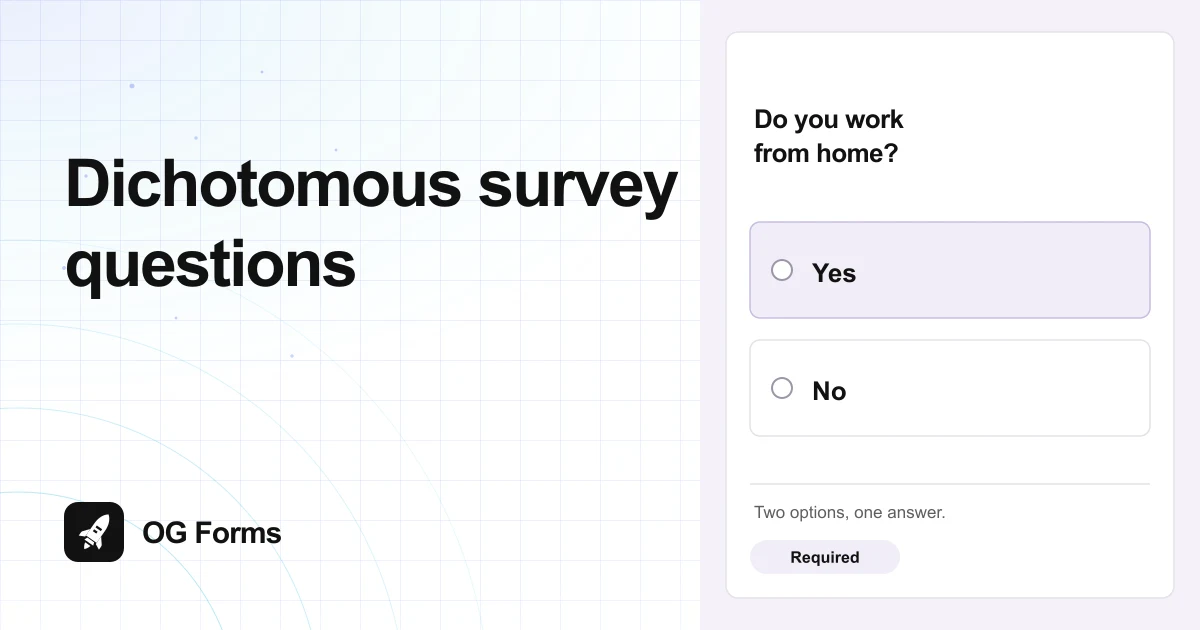
A dichotomous question offers exactly two answers, usually Yes and No, True and False, or Agree and Disagree. It is also called a binary question, a yes or no question, or a forced-choice question.
Ask about customers and satisfaction
Each question measures one thing. Where a third option belongs, it is named.
- Have you bought from us in the last twelve months? Measures whether the respondent is an active customer. Two options are enough, because the fact is either true or false.
- Did you find what you needed on your last visit? Measures task success. Add Partly if you need to know how close the visit came.
- Did you contact support in the last month? Measures support volume from the customer’s side, which usually differs from your ticket count.
- Was your issue resolved on the first contact? Measures first-contact resolution, one of the few service measures where two options beat a scale.
- Would you recommend us to a colleague? Measures advocacy. Two options here lose the difference between a mild yes and a strong one, so use a 0 to 10 scale if advocacy is what you are tracking.
- Did you use the mobile app or the website for this visit? Two options work only if those are the only two ways in. Add Both if people use both.
Ask about employee experience
- Do you have everything you need to do your job? Measures perceived resourcing. Add Mostly if you want to find the gap rather than just count it.
- Did you have a one-to-one with your manager in the last month? Measures whether the routine happens. Two options are exact.
- Do you know who to ask when you are stuck? Measures whether the escalation path is clear.
- Have you received feedback on your work in the last month? Measures feedback frequency, and pairs well with an open question about what the feedback covered.
- Did you complete the training you were assigned? Measures completion. Two options are exact, and the reason belongs in a follow-up.
Ask about product and purchase behaviour
- Have you used this feature before? Measures familiarity, which decides whether the next question should explain the feature.
- Did you compare prices before buying? Measures deliberate shopping. Two options are enough.
- Did the product arrive in the condition you expected? Measures delivery against expectation.
- Have you bought this product before? Measures repeat purchase. Two options are exact.
- Did you read the instructions before you started? Measures whether the instructions are being read at all, which decides where help content belongs.
- Is this your first time setting up an account with us? Measures new versus returning, and routes the respondent to the right follow-up.
Ask about research and screening
- Do you work in healthcare? Measures a screening condition. Two options are exact, and the answer decides whether the rest of the survey applies.
- Have you made a purchase online in the last month? Measures recency of behaviour, which predicts better than stated interest.
- Were you aware of this brand before today? Measures unaided awareness in a way that two options can carry. Order it before you name the brand anywhere else in the survey.
- Did you answer these questions honestly? Measures nothing. It is a courtesy question, and every respondent who reads it knows the answer is Yes.
- Do you consent to your answers being used for research? Measures consent. Two options are the only correct format, and No must end the survey.
- Does this household include anyone under eighteen? Measures a screening condition for products or services aimed at adults.
Ask about events and operations
- Will you attend the session in person? Measures attendance intent, and pairs with a seat cap.
- Have you submitted your timesheet for this week? Measures completion against a deadline.
- Did you receive the equipment you ordered? Measures delivery, and no third option is needed because the answer is a fact.
- Do you need an accessible entrance? Measures an access requirement. Two options respect the respondent more than an open text box, and No must not be the default.
- Is your contact number still correct? Measures data quality. Two options keep the form short.
- Did the session start on time? Measures delivery against a promise. Two options are enough because the schedule is a fact.
- Would you attend again next year? Measures return intent. Add Not sure if you are deciding on a venue for next year, because the undecided group is the useful group.
Read what a two-option answer costs you
Two options buy you a clean split. Ask “Did you find what you needed today?” and the result is a proportion: the share who said yes. You can compare that share between two groups, and track it month to month.
Two options cost you intensity. A respondent who almost found what they needed and one who found nothing both press No. The number tells you how many succeeded and nothing about how far the others fell short.
Two options also cost you the middle. Some questions have a real middle answer, such as “sometimes”, “about half the time” or “not applicable”. When that is true, a two-option question records an answer the respondent did not give.
Fix the wording that biases the answer
Four wordings tip a two-option question, and each has a replacement.
| Biased | Why it biases | Write this instead |
|---|---|---|
| “Don’t you agree the new process is faster?” | Loads the answer with a claim and a “don’t” | “Is the new process faster, slower, or about the same?” |
| “Did you enjoy our amazing service?” | “Amazing” makes No feel rude | “How was the service today? Good, fair, or poor.” |
| “Do you want to save money on your bill?” | Two different ideas in one question | “Would you like a cheaper plan? Yes or No.” |
| “You did read the terms, right?” | Assumes the answer | “Did you read the terms before accepting? Yes or No.” |
Two more rules. Never put a double negative in an option (“Not dissatisfied”). And keep the two options the same length, because a longer option reads as the more considered one.
Ask these questions in a form that records each answer against the respondent. OG Forms shows a two-option question as a button pair, so the question takes one tap on a phone.
Know when the answer should not be two options
Use a scale instead when you need intensity: satisfaction, likelihood, agreement strength or confidence. Use a list instead when there are more than two real answers, which is most factual questions. Use an open question when the useful answer is a sentence.
Two cases catch people out. A screening question about a condition is genuinely two options, and nothing else is needed. A satisfaction question is almost never two options unless you only care whether people succeeded.
Answer the questions people ask
What are the types of dichotomous questions?
Four common pairs: yes and no, true and false, agree and disagree, and this or that. A fifth is the screening pair, where one answer ends the survey.
Is a yes or no question the same as a dichotomous question?
Yes. A yes or no question is the most common dichotomous question. “Dichotomous” is the broader name and also covers true and false, and this or that.
How many dichotomous questions should a survey have?
Use them for facts and screening, and use scales for anything about strength of feeling. A survey made only of yes or no questions gives you a set of proportions and no sense of how strongly anyone felt.
What statistical test suits two-option answers?
Compare the share of yes answers between two groups with a chi-square test, or compare two proportions directly. Both need a reasonable number of responses in each cell, so a small sample gives a wide margin either way.
Why do two-option questions get so much criticism?
Because they are easy to write badly. A leading wording, a missing “sometimes” and a double negative each produce data that looks clean and means nothing.
Do dichotomous questions work on a phone?
Yes. Two large tap targets are the easiest question to answer on a small screen, which is why conversational and mobile forms use them so often.
Read the next question guide
Choose the structure of the whole questionnaire before you pick the question formats: structured survey questions covers closed, semi and unstructured side by side.
Match the question to the answer you need back: Google Forms question types explains all twelve, and which one to pick.
Run the list as a quiz or a survey: open the true and false quiz template, or ask the AI survey generator to write the two-option survey for you.